
Victoria Common Condominium: What’s Next in Condos? Geothermal Energy
The Challenge
Victoria Common Condominium: What’s Next in Condos? Geothermal Energy
The Kitchener-Waterloo region in Ontario is an up-and-coming area for homeowners and investors looking to purchase property without the sky-high prices of Toronto. With many new-build houses and condos planned and on the market, new residential developments need to stand out to compete. One of these communities is Victoria Common, by Queensgate Developments (Kitchener) Inc. When complete, it will include five mid-rise condo buildings with over 990 residential suites.
To remain competitive, the condos are contemporary in design with a brick, steel and glass façade. All units include patios, balconies or terraces. Sam DeCaria, President of Anew Building Corp., explains that energy- and cost-savings for the developer and for end-users were also very important. The option of using a geothermal district energy system, which offers 30% energy-savings when compared to other systems, was very attractive. Queensgate wanted to build a single geothermal system that would work for all five buildings to provide better energy efficiency and redundancy, ensuring that no one building could ever be without heating or cooling.
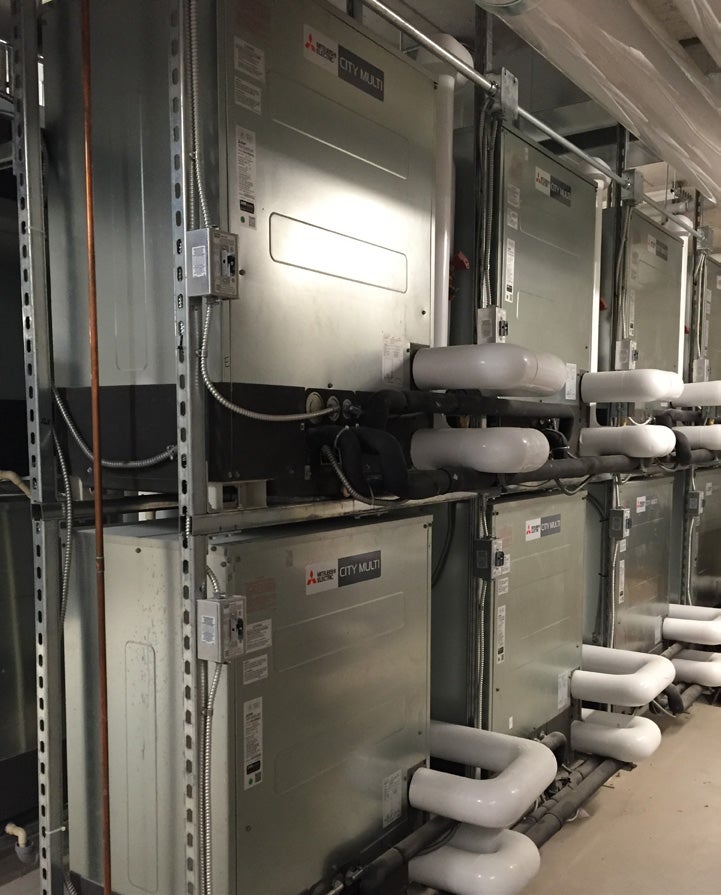
Queensgate needed a high-efficiency HVAC system that could connect to the geothermal system and reliably carry heating and cooling to each suite with the highest level of comfort and control. They chose Mitsubishi Electric’s CITY MULTI VRF (Variable Refrigerant Flow) Water-Source Heat Recovery systems. The VRF systems recover energy from zones on each floor of a building before drawing energy from the geothermal field. This means the system can draw heat from a part of the building that needs cooling and transfer it to an area that needs heating.
For example, west-facing areas can become hot in any season from sunlight streaming in. A traditional heating and cooling system would have to use energy cooling the west side while at the same time warming the east side. Instead, a VRF heat recovery system takes heat from the west and redistributes it to the east, balancing the temperature across each floor before going to the condensers and geothermal energy source.
Geothermal Energy
Geothermal energy is sustainable, renewable, reliable, low maintenance and durable, with ground loops lasting up to one hundred years. A geothermal system channels solar energy naturally stored in the earth, delivering heat when needed and providing a heat sink when cooling is required. Essentially, the ground acts like a bank of energy: some energy is deposited and some is borrowed.
At Victoria Common, a series of boreholes were drilled into the ground under the parking garage of Building A, where a system of geothermal pipes 17,920 feet in length was installed in an underground supply and return network. Fluid, tempered as it flows through the ground loop, is delivered to headers inside the building parking garage. A similar system of geothermal pipes was installed under the parking garage of Building B and is planned under Buildings C, D and E as they are built.
The Solution
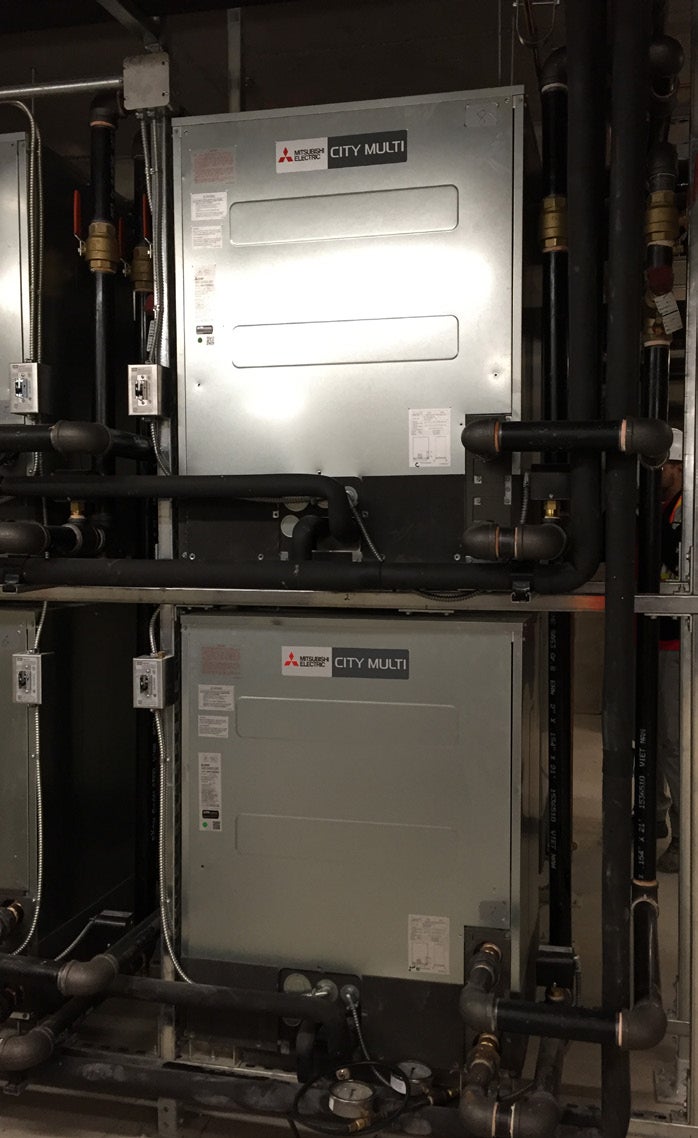
Mitsubishi Electric’s CITY MULTI VRF Water-Source Heat Recovery Systems, coupled to the geothermal system, continuously take or reject heat as required by the building. Central VRF condensing units use little electricity to exchange the water-source heat with refrigerant. Variable-drive motors send exactly the amount of refrigerant required to heat or cool the building through two small-diameter pipes to Branch Control units centrally located on each floor.
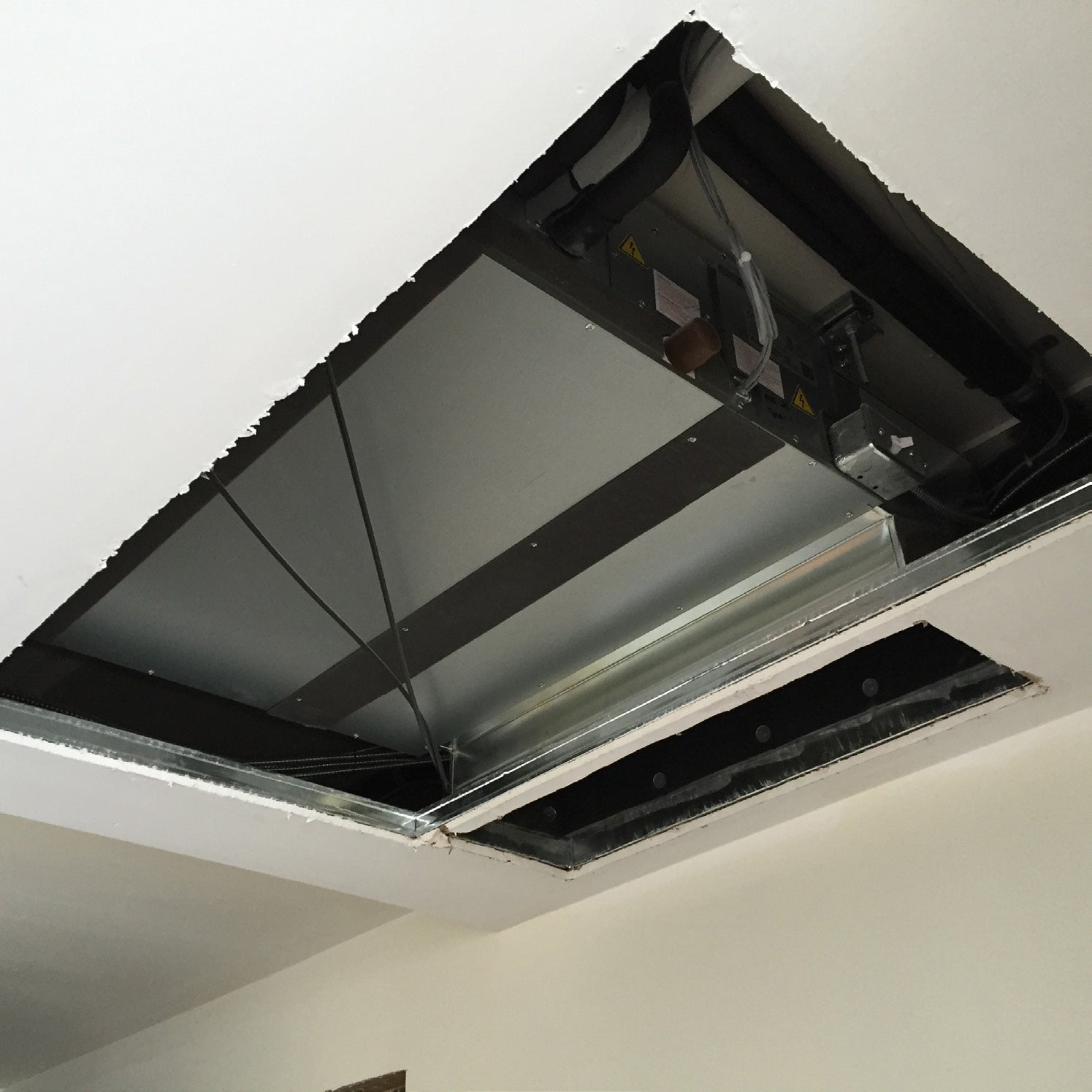
Each Branch Controller is connected by two small refrigerant pipes to up to 16 low-sound fan coil units concealed in the ceiling or walls in individual suites, each with its own fully controllable thermostat, simultaneously providing heating and cooling. The heat recovery capability of the system adds another layer of energy efficiency by extracting heat from suites requiring air conditioning and circulating it to suites requiring heating before calling for more energy from the central compressors.
Energy efficiency is created by reusing energy and moving it around before consuming electricity to create more. The geothermal/water-source heat recovery VRF system has three ways to simultaneously move and reuse energy: in the ground, in the central condenser loop and in each branch control loop. Typical COP values range from 4 to 5 during heating mode, 5 to 7 during cooling mode and 6 to 11 during spring and fall when the system is in simultaneous heating/cooling mode.
The integration of geothermal and VRF heat recovery technology is designed to provide Victoria Common residents with renewable, efficient, cost-effective, carbon-free and sustainable energy for many years.
“Variable refrigerant flow and geothermal energy are not the norm – there’s a lot at stake if it doesn’t work. There’s a big learning curve, the system has to work for all parties, and it takes time to find a comfort level. The Mitsubishi Electric brand was huge in giving us the confidence to use this technology because they’re a proven, reputable brand and company.” Sam DeCaria, President of Anew Building Corp., a partner of Queensgate Developments (Kitchener) Inc.
The Solution
Mitsubishi Electric Heating and Cooling proposed a solution that would allow the Victoria Common buildings to use a geothermal district energy system without requiring the entire infrastructure to be installed before all five buildings were built. Each building could be constructed on an independent geothermal bore-field, with multiple modular water-source VRF systems providing redundancy, high energy efficiency, individual suite controls and whole-building digital controls.
DeCaria explains that Mitsubishi Electric was selected because the company was a recognized, proven performer with experience in this technology dating back to the 1990s. The systems came with a 10-year warranty and, according to the case study, offered an additional 25% energy-savings on top of the 30% attributed to the geothermal system.
Unlike traditional systems, Mitsubishi Electric’s Water-Source VRF Heat Recovery Systems did not require water pipes or pumps throughout the building. There are no compressors in occupied suites, helping the system operate at very low sound levels, even during summer cooling. Individually metered systems allow residents to operate heating or cooling year-round according to their needs.
The in-suite air distribution units were smaller and offered more placement options. They could be concealed in the ceiling, freeing additional floor and living space and avoiding obstruction of windows.
“It was great having an association with and support from Mitsubishi. They provided a lot of time advising and reviewing documentation; it was like having a second check from a manufacturer. When they are putting their product in they are very involved.” Leon Demaiter, President of DEI Consulting Engineers
The Results
Everyone involved with the project was very pleased with the results. Mitsubishi Electric met budget constraints and worked with a third-party energy provider to provide individual suite monitoring and measuring for billing purposes.
Trained contractors, factory oversight and the 10-year warranty helped support installation quality and the reliability the client required. Since geothermal energy was a newer technology for the project team, the participants also valued Mitsubishi Electric’s experience and additional support.
Summary
Developer: Queensgate Developments (Kitchener) Inc.
Distributor: Mits Airconditioning Inc.
Engineering Consulting Firm: DEI and Associates Inc.
Architectural Firm: Architects Unfolded
Contracting Firm: Hy-Mark Mechanical Inc./Art Blake Refrigeration; Dean Lane Mechanical
Location: Kitchener, ON
Industry: Residential
Size: Building A: 77 suites, occupied 2015; Building B: 116 suites, occupied 2017; Buildings C, D and E in development
Challenges: Builder Queensgate Developments needed a competitive but highly energy-efficient heating and cooling system that could make the most of geothermal energy for its new residential condominium community.
Selection Criteria:
- Energy savings
- Design flexibility
- Proven partner
- Brand reputation
- Energy efficiency
- Cost competitive
- End-user comfort and convenience
Design/Engineering Solution:
Building A - Mitsubishi Electric Outdoor unit models:
- 16 x PQRY-P Water-Source Heat Recovery Units, 575V (condensers)
- 8 x CMB-P1012NU-GA1 Branch Controllers (heat recovery)
Mitsubishi Electric Indoor models:
- 77 x PEFY-P NMAU-E3 Horizontal, Ceiling-Concealed Indoor Units
Building B - Mitsubishi Electric Outdoor unit models:
- 24 x PQRY-P Water-Source Heat Recovery Units, 575V (condensers)
- 12 x CMB-P1012NU-GA1 Branch Controllers (heat recovery)
Mitsubishi Electric Indoor models:
- 113 x PEFY-P NMAU-E3 Horizontal, Ceiling-Concealed Indoor Units
Results:
- Very smooth performance
- Easy low maintenance
- Cost-savings for developer and end-users
- More living and floor space in each suite
- Energy-savings reported in the case study: 30% from geothermal plus an additional 25% from the VRF heat recovery system
Frequently Asked Questions
How can geothermal energy and water-source VRF work together in a condominium development?
A geothermal field can provide a stable water-source loop that a VRF system uses to take or reject heat as needed. At Victoria Common, CITY MULTI water-source heat recovery systems first reuse heat within the building and then exchange energy with the geothermal field, helping provide efficient heating and cooling to individual suites.
How does VRF heat recovery improve energy efficiency in a multi-residential building?
VRF heat recovery can move heat from areas that need cooling to areas that need heating before additional energy is drawn from the central system. At Victoria Common, this allows heat from warmer zones to be redistributed to cooler zones while supporting simultaneous heating and cooling.
What energy savings are reported for the Victoria Common geothermal and VRF system?
The case study reports approximately 30% energy savings from the geothermal system and an additional 25% energy savings from the Mitsubishi Electric VRF heat recovery system. These figures are presented separately in the source and should not be treated as a simple 55% combined savings figure.