
The Stacey House: Converting a Propane-Powered Property into an Eco-Friendly Home
The Challenge
The Stacey House: Converting a Propane-Powered Property into an Eco-Friendly Home
Wanda Stacey lives in a 3-bedroom, side-split home in Deshkan Ziibiing, also known as Chippewas of the Thames First Nation (COTTFN), roughly 20-kilometres from London, Ontario. Like more than 80 percent of the community, Stacey has relied on propane to heat her home.
Propane is not only a fossil fuel that contributes to climate change, but it’s also very expensive for users. Only about 1 percent of Canadians use it for home heating. Natural gas, another fossil fuel used for heating, is not available in COTTFN.
In spring 2022, after a detailed application process, Stacey’s home was selected for a green home retrofit project.
The Clean Energy in Remote and Rural Communities: Deshkan Ziibiing Retrofit Pilot is a collaboration between COTTFN’s Treaties, Lands and Environment department and the London Environmental Network (LEN), a non-profit that runs green building programs in the London, Ontario area. They secured grants for the work through Natural Resources Canada.
Stacey’s home would receive solar panels, new windows and doors, state-of-the-art insulation, and a new heating and cooling system. It would also be a model of how effective an energy-efficient home could be in COTTFN, both to ease the cost of living and to support the environment.
Choosing a heating and cooling system that would make the most of the retrofitting efforts, be cost-effective for day-to-day living and support the green mission of this pilot project was crucial.
“I like that with the Zuba, you can put it in, and folks can just set their thermostat like normal, and they don’t really have to think about it,” Marianne Griffith, Executive Director, London Environmental Network
The Solution
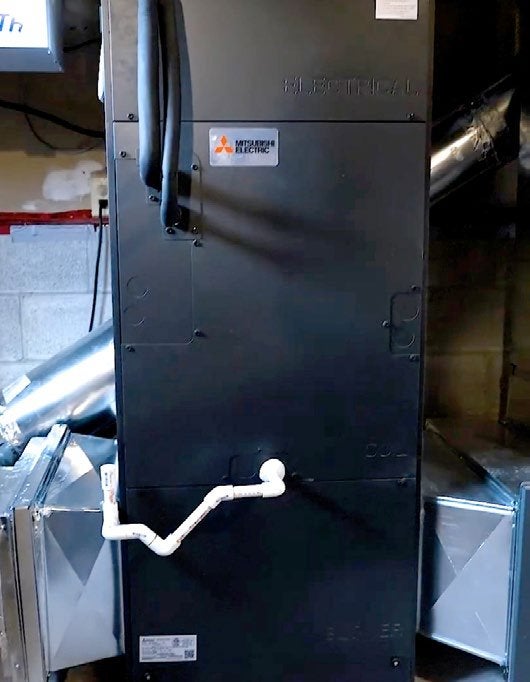
LEN Executive Director, Marianne Griffith, was closely involved in the project. As a building science expert, she heard that cold-climate air source heat pumps are highly efficient and effective electric heating and cooling systems. Consulting with Nolan Stenson at Donaldson Heating & Cooling confirmed her idea that a Mitsubishi Electric Zuba Cold Climate heat pump was ideal for the retrofit.
Mitsubishi Electric supported the selection and installation of the Zuba Central Multi-Position Air Handling PVA-A42NA indoor unit and PUZ-HA42NKA1 outdoor unit.
The system is fully electric, so Stacey would no longer need to use expensive propane to heat her home. It’s also highly efficient, using up to 50 percent* less energy than traditional systems while operating effectively in temperatures down to -30°C Celsius.
What’s more, the Zuba also makes use of existing ductwork. This feature meant installers could use the home’s existing layout and furnace room without needing to build new ducts or add overhead units. It also means efficient air conditioning can flow through the ducts too.
The Results
The retrofit was completed in autumn 2022, and the heat pump was turned on. An open house for the newly retrofitted home attracted a lot of interest from the community, living up to the pilot project’s goal of engaging with other community members about energy efficiency.
Homeowner Stacey is pleased with the solution too. While the new technology was a change at first – she no longer needs to do all the little steps she used to take to keep in the heat – she is keen on the comfort, quiet operation and cost-savings she’s experiencing.
When the retrofit began, propane cost Stacey about 97 cents per litre. Now all the updates have been completed, Wanda is receiving credits from the electricity company for the excess electricity she’s returning to the grid. Whereas before, heating and cooling was almost half her energy usage. Now her house is so efficient that her solar panels often capture more energy than she needs.
Overall, Stacey is very happy to be off fossil fuels and using a more energy-efficient and eco-friendly option to heat and cool her home. “It’s wonderful,” she says.
Summary
Client: Wanda Stacey and the London Environment Network
Location: Chippewas of the Thames First Nation, Muncey, Ontario
Engineering consultant: Andree Kiernan
Contracting firm: Donaldson Heating & Cooling
Challenge:
The client needed an energy-efficient cold-climate HVAC system to get off fossil fuels and improve day-to-day costs and support net-zero building goals.
Key criteria:
- Energy efficient
- Electric (non-fossil fuel)
- Heating and cooling capacity
- Ability to use existing ductwork
Solution:
The Zuba Central Multi-Position Air Handling PVA-A42NA indoor unit and PUZ-HA42NKA1 outdoor unit provide an energy-efficient way to switch off propane, bypassing natural gas, that also accommodated the existing ductwork.
Results:
The client is pleased with the ability to cut down on costs and do something better for the environment without compromising on comfort.
Frequently Asked Questions
How can a cold-climate heat pump replace propane heating in an existing home?
A fully electric cold-climate heat pump can provide both heating and cooling without relying on propane. In the Stacey House retrofit, a Mitsubishi Electric Zuba system replaced propane heating and was designed to operate effectively in temperatures down to -30°C.
Can a cold-climate heat pump use a home’s existing ductwork?
Yes, depending on the home and system design. The Zuba Central system used at the Stacey House was connected to the existing ductwork and furnace-room layout, avoiding the need to build new ducts or add wall-mounted indoor units.
How can an all-electric HVAC retrofit support an energy-efficient home?
An efficient electric heat pump can reduce fossil-fuel use while providing year-round comfort. At the Stacey House, the heat pump was part of a broader retrofit that also included solar panels, insulation, windows and doors, helping the home reduce energy use and return excess solar electricity to the grid.