
Solo District: Reaching New Heights in Heating and Cooling
The Challenge
Solo District: Reaching New Heights in Heating and Cooling
Located in the vibrant community of North Burnaby, British Columbia, just a short drive from Vancouver, Solo District is a mixed-use development that includes four towers with residential, office and commercial space. Jim Bosa, President of Appia Development, the developer of Solo District, had a clear vision - to create a community complete with everything the residents might need, from doctors’ offices to grocery stores to event spaces.
The first of four construction phases was completed in 2015, and phases three and four are scheduled for completion through 2022. During the development process, Appia Development was looking for a heating and cooling solution that was of excellent quality and energy efficiency, while being cost effective during the installation process and throughout the product lifecycle. Ease of operation, future compatibility and reduced cost were also key considerations.
“We look for opportunities to create new neighbourhoods and build quality into communities that are emerging or on the cusp of change. This offers real value to our customers. They count on us and we deliver.” Jim Bosa, President, Appia Development
“Mitsubishi Electric played a huge role in providing energy-efficient systems with Integral Group’s lead on the engineering design. I’ve been working with Mitsubishi Electric on this project for the past nine years and it has been an absolute pleasure dealing with their technical and support staff. They are industry leaders in heating and cooling.” Sharn Chana, Principal, IntegralGroup
The Solution
Mitsubishi Electric’s Water-Source VRF and Heat Pumps serving the residential, commercial and retail buildings were selected for this development. For the grocery store Mitsubishi Electric’s Hydronic Heat Recovery was selected.
Mitsubishi Electric products were chosen for its flexibility, heat recovery and overall product excellence. The fact that the control systems were all included was also a deciding factor, as traditionally control systems belong to a third party, which makes operation more complicated and leads to ongoing service and maintenance.
Mitsubishi Electric’s system also has backward and forward compatibility, meaning the systems can “speak” to older and future systems that may be added to new buildings in the complex. Mitsubishi Electric systems are also excellent at redirecting heat from an area that needs cooling, for example the kitchen, to an area that needs warming, like the residential hot water.
Another consideration was that Mitsubishi’s Electric two-pipe VRF system is less labour intensive during installation than traditional four-pipe systems. This reduces installation time and costs. To ensure the success of this project and the systems used, Mitsubishi Electric Sales Canada Inc. worked closely with the owner, architect and engineers involved in the design of the mechanical system to earn their trust. Also involved was a third-party utility company that ultimately took ownership of the common space mechanical system components, including the geothermal field and the Citi Multi system.
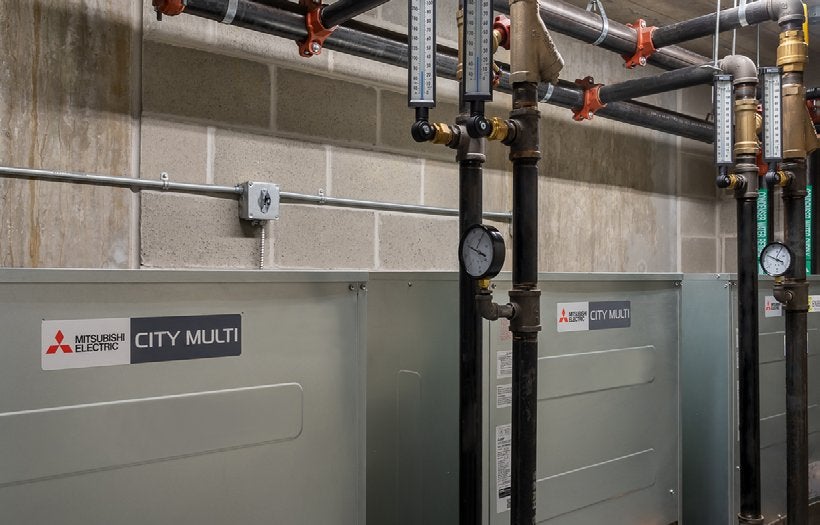
As the towers range from 41 to 55 storeys in height, Solo District now boasts the tallest building in Canada to use VRF technology. Because of the unique height requirements, Mitsubishi Electric Sales Canada Inc. had the first ever 575-volt condenser system designed, manufactured and delivered to this project. The mechanical design includes a development-scale vertical closed loop geo-exchange system and “ambient temperature” loop with interconnecting capabilities of the individual building hydronic heating and cooling systems. Essentially, this means that the Mitsubishi Electric system can draw energy from virtually any water source, whether it’s a geothermal loop or a traditional boiler chiller.
Results
The Solo District buildings can now boast that they are the tallest in Canada with a VRF system. After nine years, phases one and two are now wrapped up and the project is considered a success that will be further developed in phases three and four.
Solo District’s successful completion of the first two key phases is transforming life in Burnaby, creating a vibrant community that is well connected to Vancouver.
Summary
Summary
Owner/Developer: Appia Developments
Distributor: Mitsubishi Electric BC Office
Mechanical Engineers: Integral Group
HVAC Contractor: Enersolv Design & Build Ltd.
Architectural Firm: Chris Dikeakos Architects Inc.
Location: Burnaby, British Columbia
Industry: Mixed use residential & commercial
Size: 4 towers ranging between 41 to 55 storeys with a total of 1351 suites, 100,000 square feet of shops and 400,000 square feet of office space built on 6.06 acres of land.
Challenges:
Select an energy efficient and cost-effective heating and cooling solution for a master-planned, mixed-use residential, office and commercial community in BC.
Selection Criteria:
- Excellent quality
- Energy efficiency
- Proprietary control systems
- Installation time and cost
- Cost effectiveness
Design/Engineering Solution:
Indoor Unit Models:
- 510 - PEFY-P**NMSU
- 399 - PEFY-P**NMAU
- 26 - PEFY-P**NMHU/NMHSU
- 10 - PKFY-P**MHMU/NKMU
- 8 - PLFY-P**NCMU/NBMU
Outdoor Units Models (Phase 1 & 2):
- 335 - PQRY/PQHY-P**ZKMU-A
- 1 - PUHY-96TKMU-A
- 2 - PUMY-P48NHMUR4
Results:
- Solo District’s successful completion of the first two key phases is transforming life in Burnaby, creating a vibrant community that is well connected to Vancouver.
Frequently Asked Questions
How can water-source VRF support a large mixed-use development?
Water-source VRF can serve residential, office and retail areas while providing flexible zoning and heat recovery. At Solo District, Mitsubishi Electric water-source VRF and heat pump systems were selected for multiple building types within the development.
How can heat recovery improve HVAC efficiency in a mixed-use building?
Heat recovery can redirect energy from areas that need cooling to areas that need heating or hot water. In the Solo District design, recovered heat could be moved from spaces such as kitchens to uses such as residential hot water.
Why can a two-pipe VRF system help reduce installation complexity?
A two-pipe VRF system can require less labour than a traditional four-pipe arrangement. For Solo District, this was identified as a way to reduce installation time and cost while maintaining integrated controls and future system compatibility.