
Sifton Centre Creating Sustainable Communities with Net-Zero Design
The Challenge
Sifton Centre: Creating Sustainable Communities with Net-Zero Design
Sifton Properties, a land developer operating in office, retail, industrial and residential construction and leasing, is embarking on its most ambitious project this year - creating the most sustainable, energy-efficient community in Ontario.
Located in London and named West 5, the project will include residential apartment buildings, townhomes, a retirement home, grocery store and medical offices. In total, there will be approximately 2000 residential units and 250,000 to 300,000 square feet of commercial construction. The entire master-planned community will take about 10 years to complete.
The cornerstone of this project is Sifton Centre, which was completed in 2016. As the first building in the community and the developer's main space, the Sifton Centre needed to model everything the community was going to be - innovative, technologically advanced and energy efficient.
With net-zero energy consumption as the goal, every aspect of the design was carefully considered, from solar panels to LED lighting to ultra-tight insulation. For the heating and cooling system, Neil Carter, Director of Commercial Construction at Sifton, explains that energy efficiency, cost effectiveness and the best payback period were the key considerations.
“Looking at our energy modelling and some of the invoices that we get from our local utility, I think the Mitsubishi Electric system is the most cost-effective and energy-efficient solution you could put into a building of this size.” Neil Carter, Director of Commercial Construction, Sifton Properties
The Solution
Because net-zero construction was such an important feature for this project, Sifton worked with Smith and Andersen Ltd., an engineering consulting firm, to conduct energy modelling to determine the most efficient HVAC system that would also be the most cost effective.
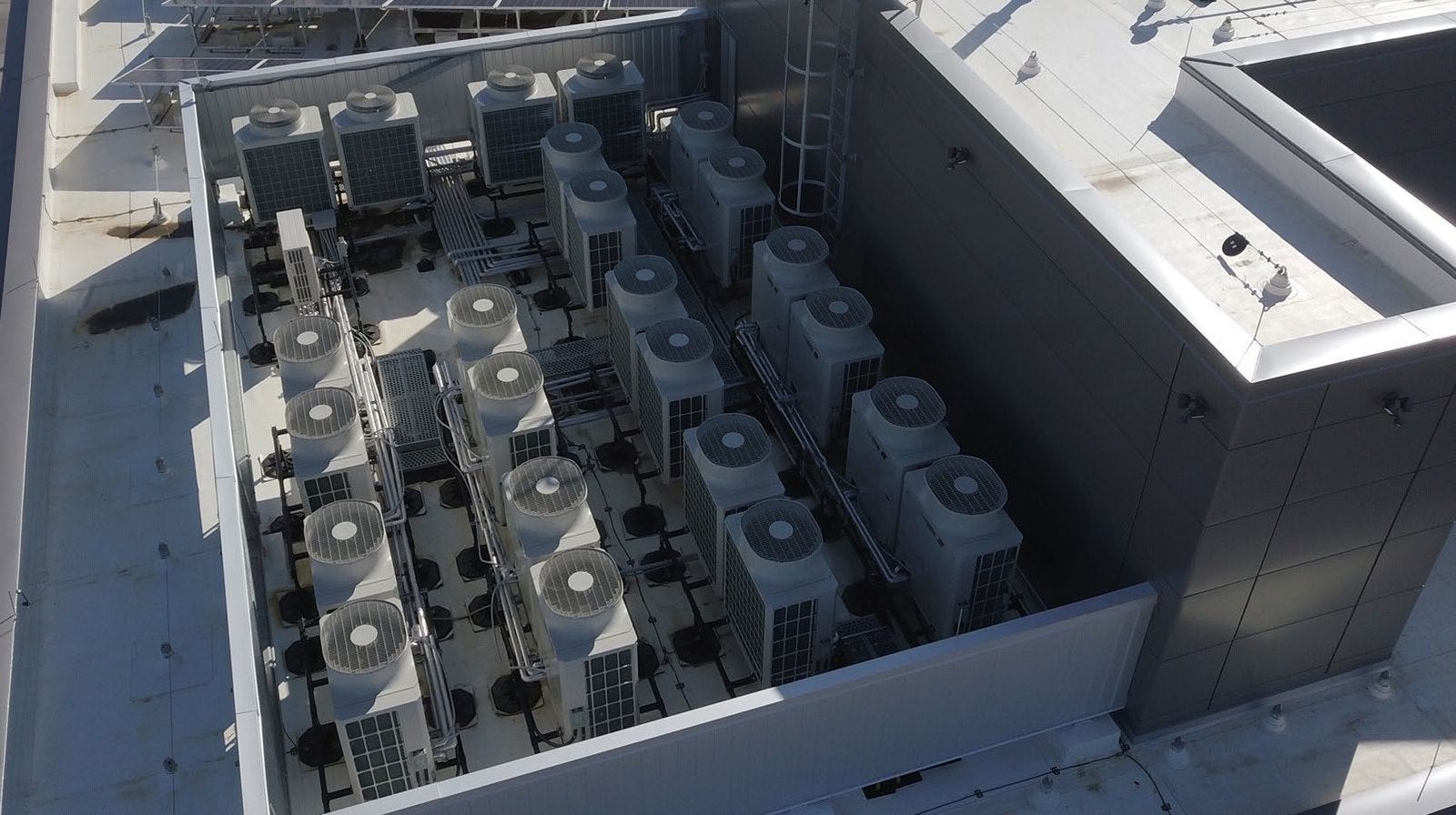
The results of the energy modelling revealed that an electric air source variable refrigerant flow (VRF) system was the best option.
Sifton decided to set up an open bid for HVAC companies to compete to win the business. After accepting three bids, Sifton selected Mitsubishi Electric's City Multi Air Source system, as it met all their criteria the best. Smith and Andersen then proceeded to design the building around Mitsubishi Electric's Heating and Cooling systems.
The Results
After using their new office space for three years, Sifton is very pleased with their HVAC system. Carter reports that year-round, including throughout winter's below-freezing temperatures and summer's heat waves, everyone is quite comfortable in the building. Even -20°C temperatures are no match for the fan coil and condensing units, which are able to completely provide all the heat required throughout the building.
In terms of energy efficiency, Carter confirms the system is extremely efficient, "exactly as we modelled it."
In fact, the system works so well with the building's other net-zero construction features that the building actually produces more energy than it consumes (is net positive) and Sifton receives a credit on their monthly utility bills.
Eric Shaw, Regional Sales Manager at Baymar Supply Ltd., Mitsubishi Electric's distributor for the region, says Sifton is so pleased with the results that they have already signed on to use Mitsubishi Electric Heating and Cooling in three more buildings, plus their residential projects.
“A net-zero home gets you to the next level, not just in building code. It also allows you to virtually come off the grid. On an annual basis, it would produce as much energy as it uses, including space heating, cooling, ventilation, hot water heat and all household electrical consumption.” Richard Sifton, President, Sifton Properties
Summary
Owner/Developer: Sifton Properties
Distributor: Baymar Supply Ltd.
HVAC Contractor: JMR Electric + Mechanical
Engineering Consulting Firm: Smith and Anderson Ltd.
Architectural Firm: Diamond Schmitt Architects
Location: London, Ontario
Industry: Office
Size: 60,000 square feet
Challenges:
Create a net-zero energy building cost effectively, where the energy being consumed is also being produced by the building.
Selection Criteria:
- Energy efficiency
- Cost effectiveness
- Payback period
- Low maintenance
Solution:
Mitsubishi Electric Indoor Unit Models:
- 17 X PEFY-P08NMAU-E3
- 17 X PEFY-P12NMAU-E3
- 17 X PEFY-P18NMAU-E3
- 17 X PEFY-P24NMAU-E3
- 6 X PEFY-P30NMAU-E3
- 2 X PWFY-P36NMU-BU hot water booster units
Mitsubishi Electric Outdoor Units Models:
- 8 X PURY-HP72TKMU-A
- 12 X PURY-HP96TKMU-A
- 4 X PUHY-HP96TKMU-A (DOAS)
Results:
- Net-positive energy usage
- Very low maintenance
- Comfortable indoor temperatures
Frequently Asked Questions
How can a VRF system support a net-zero office building?
A high-efficiency electric VRF system can reduce the energy required for heating and cooling as part of a broader net-zero design. At Sifton Centre, energy modelling identified an air-source VRF system as the most efficient and cost-effective HVAC option, and the completed building produces more energy than it consumes when combined with its other net-zero features.
Can an air-source VRF system provide heating during cold Canadian winters?
Yes. Performance depends on the equipment and system design. At Sifton Centre, the fan coil and condensing units were reported to provide all of the building’s required heat even at -20°C while maintaining comfortable indoor temperatures.
What factors should be considered when selecting HVAC for a net-zero building?
Important considerations include energy efficiency, cost effectiveness, payback period and maintenance requirements. These were the main HVAC selection criteria used for Sifton Centre after detailed energy modelling of the building.