
Rogers Place World-Class Cooling Equipment for a World-Class Arena
The Challenge
Rogers Place: World-Class Cooling Equipment for a World-Class Arena
Rogers Place is a newly built indoor multi-use arena in Edmonton, Alberta. It’s the new home of the NHL’s Edmonton Oilers as well as a concert and event venue. Owned by the City of Edmonton, the ambitious project cost over $614 million, took over two years to build, and officially opened on September 8, 2016.
The large-scale, high-profile project was funded by several sources and closely watched by the public. Therefore, it required close attention to details and needed suppliers who could meet escalated timelines. Rogers Place was also designed to be LEED-certified, so suppliers were required to provide energy-efficient products that could meet LEED Silver standards.
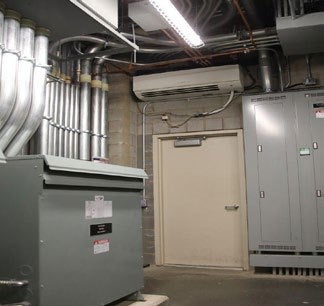
Within this context, one of the top priorities was proper cooling for all the electrical rooms that are in place throughout the building. These electrical rooms serve as power feeds for basic electrical requirements throughout the building, such as lights and power outlets. Other rooms that required cooling include the demarcation, audio, fire command and the elevator machine rooms.
“It’s nothing short of phenomenal. The way it’s put together is ingenious. It is created and crafted and it has every amenity imaginable. The finishing touches and the way the building flows and the sight lines, incredible.” Gary Bettman, NHL Commissioner (NHL.com)
“We have essential equipment within our electrical room, and temperature control is the primary concern. We needed to ensure that the electrical equipment does not overheat.” Jason Rimmer, Director, Engineering & Ice Operations for Rogers Place
“We’ve always liked Mitsubishi Electric equipment and it’s always been high end. So on a project like this we didn’t want to gamble on a manufacturer. It’s worked out great.” Cory Somers, Managing Director, Sercon Refrigeration
The Solution
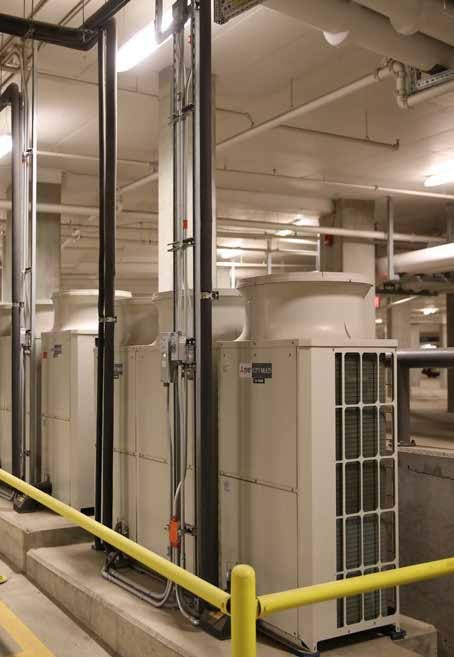
Sercon Refrigeration won the contract for supplying and installing all the VRF (Variable Refrigerant Flow) systems in the arena and selected Mitsubishi Electric City Multi VRF for the equipment. Rogers Place has a number of rooms that required cooling and the ductless split solution was the best fit for its needs. It allowed for easier installation and is more flexible than alternative solutions.
In addition to the performance benefits, the models chosen differ from a conventional air conditioning system that turns on and off to meet the temperature set on the thermostat, then waits for the temperature to fluctuate before turning on again. Instead, the systems used in the Rogers Place Arena modulate to maintain the set temperature.
This results in higher energy efficiency than conventional equipment because less power is used. Rahim Rawji, Product Application Specialist at Klass Mechanical, explains that there were restrictions on the spacing allowance for the piping between the units. Klass Mechanical and Sercon Refrigeration had to work with the engineers to adapt the system to fit the space requirements. As an added bonus, the condensing units were placed in the underground garage and therefore the heat extract from the electrical rooms has helped to heat this space.
The Results
The Mitsubishi Electric system is working smoothly and efficiently. Overall, Rogers Place has received numerous accolades, including being named one of the best stadiums of 2016 by Sports Management and receiving the Engineering News-Record Global Best Projects – Award of Merit, Sports/Entertainment. It has also triggered a boost in tourism and hospitality and is the main attraction of the Ice District – a mixed-use sports and entertainment district being developed around the arena.
Summary
Company: City of Edmonton & Edmonton Arena Corporation
General Contractor: PCL Construction
Mechanical Contractor: April’s North
HVAC Sub-Contractor: Sercon Refrigeration
Distribution: Klass Mechanical
Engineer: ME Engineers/Hemisphere Engineering Inc.
Architectural Firm: 360 Architects/HOK, DIALOG, Manica Architecture, Arndt Tkalcic Bengert
Industry: Sports & Entertainment
Size: 1.1 million square feet
Challenges:
As the new arena for Edmonton Oilers, this was a high-profile new construction project. As such, it was under tight timelines and needed suppliers who could meet escalated deadlines and had products applicable to LEED Silver standards.
Selection Criteria:
- Energy efficiency to meet LEED Silver
- State-of-the-art product
- Reputation for quality and performance
Design/Engineering Solution:
Mitsubishi Electric Outdoor unit models:
- 2 X PUMY-P48NHMU
- 3 X PUHY-P72TKMU-A
- 2 X PUHY-P120TKMU-A
- 1 X PUHY-P144TKMU-A
- 2 X PUHY-P168TSKMU-A
- 6 X PUHY-P192TSKMU-A
Mitsubishi Electric Indoor unit models:
- 22 X PKFY-P18NHMU-E2
- 75 X PKFY-P24NKMU-E2
Other Mitsubishi Electric products:
- PAR-FL32MA (controls)
- PKA-A24KA4.th
- PUY-A24NHA4
- PAR-31MAA-J
Results:
- Equipment contributed to success for Rogers Arena
- Rogers Arena is spurring tourism and development to the region
- Energy-efficiency and smooth performance
Frequently Asked Questions
Why do electrical rooms in arenas need dedicated cooling?
Electrical rooms contain essential power and control equipment that can generate heat during operation. Dedicated cooling helps maintain stable temperatures and reduces the risk of critical electrical equipment overheating.
Why can VRF be a good fit for cooling electrical and equipment rooms?
VRF and ductless systems can provide flexible installation and precise temperature control across multiple rooms. At Rogers Place, the selected systems modulate to maintain the set temperature rather than simply cycling on and off, helping improve energy efficiency.
Can heat removed from electrical rooms be reused elsewhere in a building?
Yes, depending on the system and building design. At Rogers Place, condensing units were installed in the underground garage, where heat extracted from the electrical rooms helped warm the garage space.