
Fuel-Switching Hydronic Systems to Low-Carbon with Air-to-Water Heat Pumps
Canadian Air-to-Water Heat Pump Fuel-Switching Energy Study
A2L Canadian Air-to-Water Heat Pump Fuel-Switching Energy Study
Protecting the environment has become a top priority for governments. As new policies are implemented to reduce our carbon footprint, one industry that’s seeing significant changes is construction. With the federal government imposing a carbon tax that is planned to increase every year and declaring that all new builds must be net-zero ready by 2030, the industry must find solutions to keep emissions and costs down.
A powerful way to reduce energy consumption and carbon emissions is using an air-to-water heat pump for year-round heating and cooling. Extremely efficient, heat pumps minimize the need for natural gas. They work by transferring thermal energy by using electricity instead of fossil fuels, and are ideal for a wide range of projects, from single-family homes to large, multi-unit buildings. Reversible heat pumps can provide chilled water in summer for cooling, and produce hot water in winter for heating.
While heat pumps are becoming increasingly popular, some designers are concerned about their ability to provide enough heating capacity during our cold Canadian winters. To confirm they’re up to the task, Mitsubishi Electric retained Intertek, a leading global testing and certification organization, to investigate by conducting an evaluation.
Using energy simulation software, Intertek evaluated the Mitsubishi Electric air-to-water heat pumps by modelling its operation in a typical building. Simulations were done for three cities that represent different climates across Canada — Toronto, Vancouver and Montreal. The goals were to confirm what energy savings and carbon emission reduction can be achieved with a heat pump in various cold climates and to understand if enough heat can be generated in freezing weather, so a boiler supplements the building’s needs only on extremely cold days.

Designing an HVAC system for maximum energy efficiency
To ensure the results would be comparable across the three cities, Intertek retrofitted an existing building model and simulated local temperatures based on historical weather data.
The selected space was a six-storey hotel that’s representative of a typical commercial building or multi-unit residential building (MURB). It includes 179 guest rooms; a fully conditioned basement; plus retail space, a lobby, café, laundry, storage and mechanical rooms on the ground floor.
One of the requirements for the retrofit was that both heat and air conditioning be available year round. This is a common ask for most modern buildings, and it lets each zone within the building have individually adjustable temperature settings to maximize occupant comfort.
Before this analysis, the hotel had a traditional chiller and boiler system powered by natural gas. Engineers adapted it to model an air-to-water heat pump system that provides both heating and cooling and is supplemented with a natural gas boiler, as required.
Since this was a retrofit, the engineers sized and prioritized the staging of the heat pump units to meet the cooling requirements. Any available units that can produce heating are used to offset boiler usage, and therefore natural gas. In practice, this means that during the hottest days, all units are used for cooling. During the coldest days, when demand for heat is highest, all units are directed to produce heat. In between these extremes in the shoulder season, some units can operate in heating while others are in cooling.
In the peak of winter, if all units are in heating mode and can’t meet demand, an auxiliary boiler is available. While the units can operate in temperatures as low as -15°C, in this application they were sized to work down to -10°C — that’s when it’s too cold for the heat pump system to operate at peak performance in this particular application.
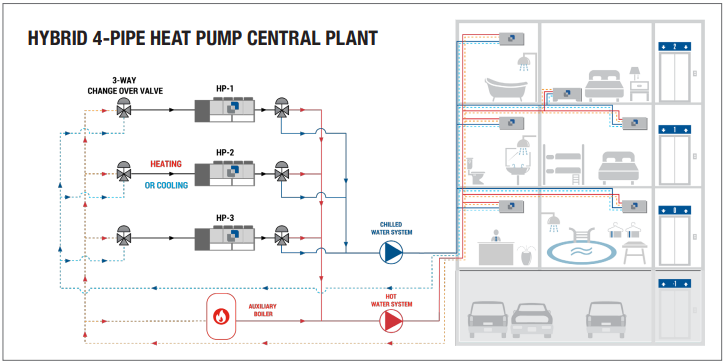
Powering measurable energy savings in large buildings
Intertek’s rigorous modelling simulations show significant energy savings and carbon emission reductions are possible when switching from a traditional boiler and chiller system to a heat pump system. After simulating performance over an entire year for each location, the modelling shows an average of 23% energy savings across the three cities, with Vancouver reducing energy use by 24.3%, Toronto by 23.7% and Montreal by 20.7%.
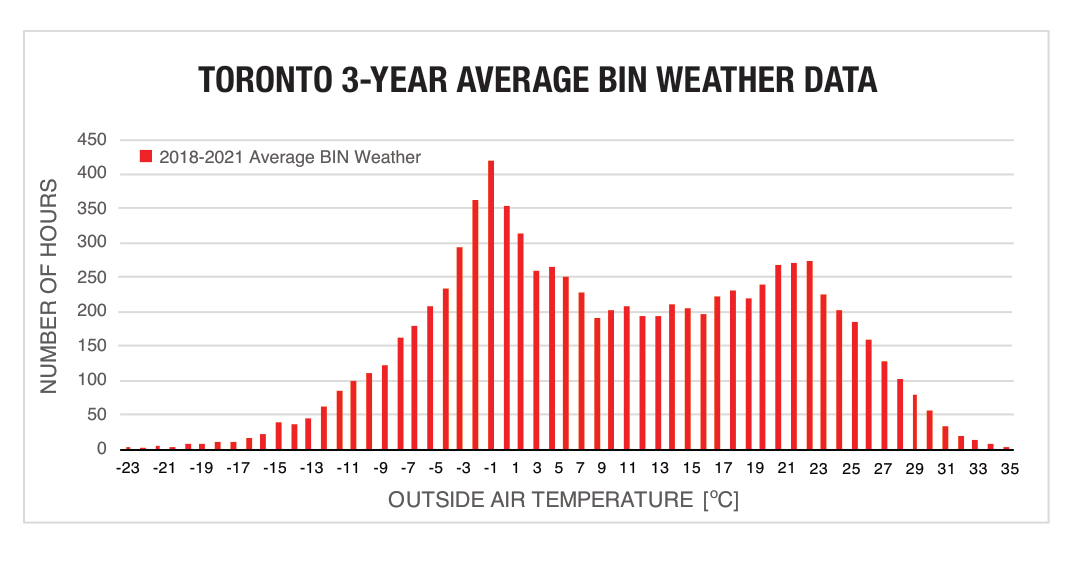
Escalating carbon tax means heat pumps bring larger savings
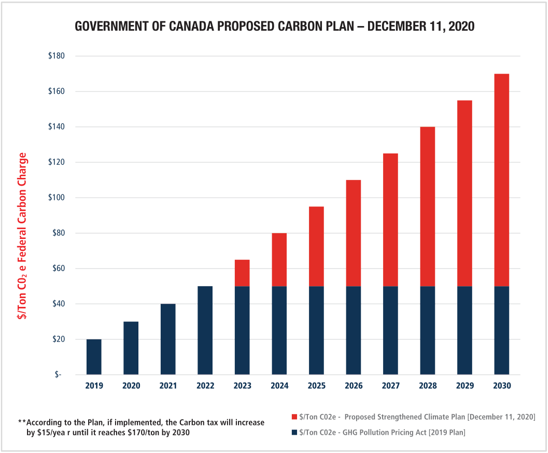
As we move towards a net-zero future, this modelling simulation demonstrates that a heat pump system is a fantastic tool for reducing energy use and carbon emissions in large-scale commercial and residential buildings, while maintaining indoor occupant comfort. When we take rising carbon pricing into account, the savings are even greater. For example, we know the federal carbon tax will be $50/ton in 2022. According to the modelling, heat pumps can offset 208 tons of carbon every year, on average — this means $10,400 of annual savings. Once planned legislation increases the tax to $170/ton by 2030, these savings will grow to $35,360 a year. Taken together, these predictable long-term savings on carbon taxes and energy usage mean a heat pump system can quickly pay for itself. Depending on local financial incentives for green energy, even more cost savings are possible.
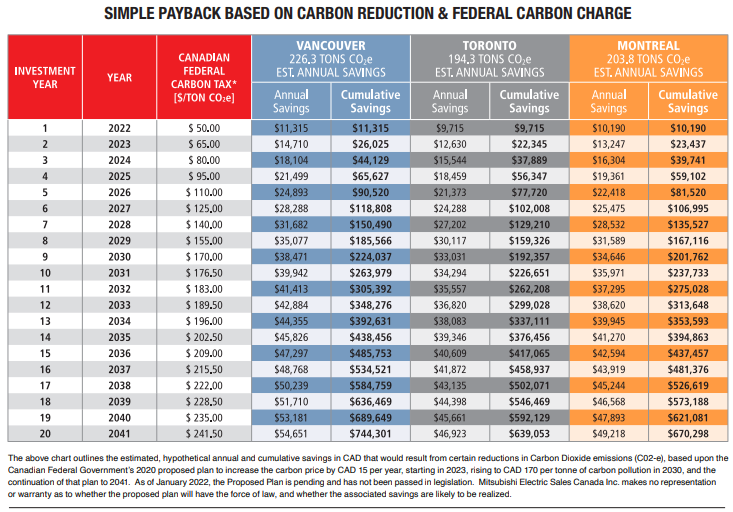
To illustrate the simple payback period based on potential carbon tax savings, we can assume a 20-year equipment lifecycle for the heat pumps and use an escalating carbon tax as currently proposed by the Canadian federal government of $170/ton by 2030 and $300/ton by 2050.
Using a value of $175,000 as the incremental cost of a heat pump over a conventional like-for-like replacement, approximately $1000/ton incremental cost, for a 175-ton central plant retrofit, the simple payback in all three locations is less than nine years.
The Canada Green Building Council’s recent study, “Decarbonizing Canada’s Large Buildings”, provides detailed modelling analyses of various building archetypes in multiple cities. It summarizes the strategies and policies needed to achieve Canada’s climate targets for existing building retrofits.
The three main technical solutions that are recommended for retrofitting the country’s existing building stock include:
- Reduce/replace fossil fuel use for space heating, mainly through electrification
- Implement energy demand-reduction measures, e.g., building-envelope upgrades
- Incorporate and/or install onsite renewable energy systems
It’s important to note that this study addresses the fuel-switching component of a very broad problem. However, it finds that carbon emissions and energy usage can be reduced significantly with a simple retrofit of the central plant to heat pumps, without the major costs associated with building-envelope upgrades.
Of course, demand-reduction measures are equally important and will further reduce the amount of energy use and carbon emissions of the building. But this study reaffirms that partial fuel switching using air-to-water heat pump technologies is indeed a viable economic solution for carbon reduction and provides one accessible option that allows building owners to better plan capital projects.
While natural gas may never be eliminated from existing buildings in Canada, better combinations of energy technologies can reduce emissions and provide a path towards a low-carbon future. Another benefit of an electric heat pump with a supplementary natural gas boiler is energy diversity and redundancy, which is key for ensuring a reliable heating source is available in case any system goes off grid.
At the same time, our current electric grid can’t handle switching all buildings to electric heat without significant upgrades. Heat pumps therefore represent a more holistic and realistic approach for reducing the carbon footprint of our buildings — a necessity for meeting government net-zero mandates coming soon.
FAQ's
What does the Intertek modelling show for professionals planning hydronic retrofits?
The study shows that replacing a traditional boiler and chiller system with an air-to-water heat pump central plant can meaningfully reduce energy use, natural gas consumption and carbon emissions while maintaining year-round heating and cooling.
How can a hybrid air-to-water heat pump system support cold-climate building design?
The modelled system uses air-to-water heat pumps as the primary heating and cooling source, with a supplementary natural gas boiler available during extreme cold conditions. This approach helps reduce fossil fuel use while maintaining heating reliability in Canadian climates.
Why is partial fuel switching relevant for building owners, engineers and HVAC professionals?
Partial fuel switching offers a practical retrofit path for existing commercial and multi-unit residential buildings. It can reduce emissions and operating costs without requiring immediate full electrification or major building-envelope upgrades, helping owners plan lower-carbon capital improvements.